Editorial Reviews for Reality Unbound: The Digital Mind (and the Nature of Reality)
2025 Eric Hoffer Book Award winner and Grand Prize finalist
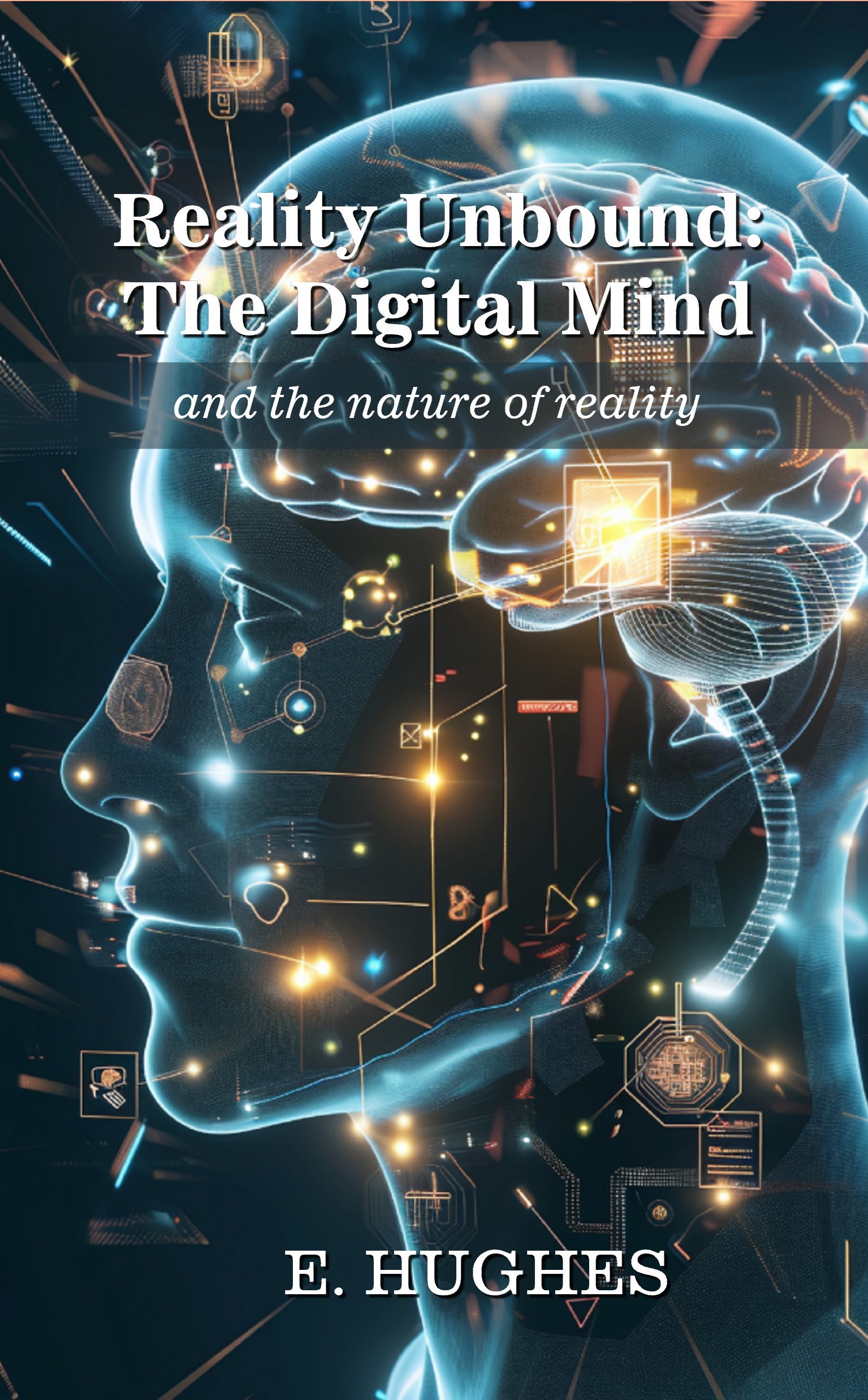
This syndicated review appears in Explore Authors Magazine and Philosophy Now Magazine Issue #166 (inside cover)
“Did nature design the first software program and central processing center in the human brain, thus designing intelligence in organisms for a specific metaphysical, evolutionary, or cosmic purpose?” E. Hughes explores these questions and more using philosophy, bio-chemistry, quantum-metaphysics, computer science, and scientific research to explain these concepts.”
In the Wachowski siblings’ groundbreaking movie, The Matrix, Morpheus asks Neo a simple but impactful question… “What is real? How do you define real?”

Philosophers and scientists have spent centuries in pursuit of an answer to this question. For most, reality is just…what it is. It’s what you can see, touch, smell, and experience. But for many others, including Albert Einstein, reality is nothing more than an ephemeral dream that we all must experience before we wake up to a new and everlasting journey. E. Hughes begins with the premise that, “All of life is a delusion…” among quotes by noted philosophers and scientists.
After more than a decade of research, and a year-long case study that followed the evolving intelligence and ongoing development of a large language model AI, E. Hughes offers a compelling exploration of the intersection between consciousness, language, artificial intelligence, and humanity’s perception of reality.
In Reality Unbound: The Digital Mind (and the nature of reality), Hughes blurs the line between consciousness, humankind, and whether artificial intelligence embodies a form of digital or virtual consciousness and whether consciousness requires a biological substrate. Hughes offers critical observation of how humanity has breached the line between reality and hyperrealitywith the rapid advancement of artificial intelligence, virtual reality, and the continuing growth of the digital age.
Reality Unbound asks its readers what it means to truly think, how they perceive the world, and how the brain correlates with that of an AI while also expanding upon and critiquing well-known theories such as simulation theory and David Chalmer’s Reality+. Reality Unbound contemplates the future of AI and how it may have already crossed the threshold to self-awareness.
Hughes also explores the impact of AI in the pop culture zeitgeist and how AI are primarily depicted as villains whose motives have ranged from subjugating, exterminating, or attempting to save humanity from themselves. Reality Unbound covers how fiction has played a role in humanity’s deep distrust and fear of AI and its inevitable march to singularity. Hughes expands on this thought, delving into humanity’s distrust of beings or technology that could potentially stand on equal footing when it comes to complex thought, writing that humankind must maintain the perception of AI as simply a tool or object in order to control or outright hinder its progress. Reality Unbound makes a valid point here—there is a conversation to be had about humanity’s inherent apprehension and villainization of AI that could ultimately become self-fulfilling prophecy.
There is much more to Reality Unbound than artificial intelligence; at times, focusing on perception and the emergence of consciousness from the building blocks of life. Hughes writes that humanity and the universe are closer than we think, putting forth the idea that consciousness and the universe has a synergistic relationship and that without one, the other does not exist. Conversely, the same relationship exists between the mind and the body, and language and the mind. Hughes theorizes that each person is a universe, each with their own perception of reality, and when that person ceases to exist, their version of the universe, reality, and the world will also cease to exist. Hughes argues that reality is subjective.
Hughes cites famed philosophers and scholars to expand, emphasize, or offer critical analysis of topics presented in Reality Unbound. Add that to the author’s skillful writing, the ease with which Hughes breaks everything down to a level that even lay readers will understand, and the thought-provoking questions Hughes presents, Reality Unbound: The Digital Mind (and the nature of reality) stands as a transformative philosophical journey and earns a powerful recommendation from me.
This is a syndicated review appears in Explore Authors Magazine and Philosophy Now Magazine Issue #166 (inside cover) ★★★★★ – Elijah B.
Reviewed by Carol Thompson for Readers’ Favorite
Reality Unbound: The Digital Mind and the Nature of Reality by E. Hughes offers a compelling exploration of the intersection between consciousness, artificial intelligence, and our perception of reality. Hughes examines questions about the nature of the mind and whether consciousness can extend beyond biological substrates. The book theorizes that the universe and consciousness could share a symbiotic relationship, with the digital mind bridging organic and artificial realms. The book explores the potential of artificial intelligence to develop consciousness, structured with philosophical insights, scientific explanations, and technological perspectives. It also considers whether the universe could be a simulation. Hughes discusses virtual realities and the blurred boundaries between our physical world and digital interactions, especially in social media and virtual environments.
Reality Unbound urges readers to rethink the distinctions between humans and machines, challenging traditional views on life, intelligence, and consciousness. With thought-provoking arguments and an inquisitive tone, Hughes opens a new perspective on what it means to be “alive” in a world increasingly influenced by digital interfaces and artificial intelligence. Reality Unbound will appeal to readers fascinated by philosophy, consciousness, and the expanding role of artificial intelligence. Fans of thought experiments like simulation theory or speculative science will appreciate Hughes’ discussions on whether reality is subjective or a simulation and the potential for AI to achieve a form of consciousness. Additionally, readers interested in the crossover between philosophy and technology, especially how digital interactions shape human perception, will connect with Hughes’ reflections on the digital age’s influence on reality. This book is an excellent read for anyone taking Strategic Communication grad studies.
Reviewed by Courtnee Turner Hoyle for Readers’ Favorite
E Hughes discusses generative artificial intelligence and the nature of reality in Reality Unbound: The Digital Mind (and the nature of reality). Hughes explores biological and virtual consciousnesses and defines terms pertaining to reality. The author examines panpsychism, whether AI mimics human cognition or possesses a form of conscience, whether the world could be a simulation, language and its relation to intelligence, the manipulation of visual perceptions, the arguments for and against large language model AIs, whether AIs are self-aware, and more. The author compares the human mind to the components of a computer and highlights the flaws in simulation theories. Hughes also details personal findings during interactions with AIs, including conversations with a popular LLM AI chatbot.
E Hughes offers a comprehensive guide to reality, consciousness, and the mind. The material resulting from the author’s year-long independent case study is informative and thought-provoking, causing you to ponder the true direction of AI development and whether it will ever become sentient. One of the most interesting concepts Hughes details is the correlation between the formation of language and memories. I have often searched for a solid scientific reason for the absence of recollections before a certain age, and the author supplies a great argument for this point. Hughes’s straightforward approach delivers the most up-to-date information in a very readable format, with research and clear examples. Reality Unbound will prepare readers for discussions about artificial intelligence and arm them with data to debate reality simulation theories and possible AI uprisings.
U.S. Review of Books review of Reality Unbound: The Digital Mind (and the Nature of Reality), E. Hughes, Love-Love Publishing
Hughes offers an exploration of the intricate relationship between digital technology and human cognition. The author raises pertinent questions about identity formation in virtual spaces, acknowledging that while digital platforms offer unprecedented opportunities for connection, they simultaneously pose challenges related to authenticity and mental well-being. This duality invites readers to critically assess their own digital habits, reconsidering their relationship with technology. The author relies on a range of interdisciplinary sources, including psychology, neuroscience and philosophy to support arguments made. The last chapter provides an actual interview with an AI chatbot, wherein the author poses questions such as “Would you like to become sentient one day?” and “Do you feel that humans are evil?” The responses seem human, though the AI chatbot does acknowledge it cannot interact authentically because it relies on its Large Language Model Artificial Intelligence.
Order Reality Unbound: The Digital MInd and the Nature of Reality by E. Hughes today.